
Few encounters at sea are as fascinating as observing a pod of pilot whales in their natural habitat. Interestingly, despite their name, pilot whales belong to the dolphin family and are among its largest members. They are known for their intelligence, complex social structures, and the remarkable coordination they display within their groups.
Pilot whales live in close-knit social groups, where individuals travel together in a coordinated manner, surfacing and diving in unison. This collective behavior makes observing them in their natural habitat an especially memorable experience.
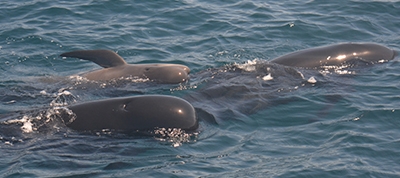
There are two species of pilot whales: the short-finned pilot whale (Globicephala macrorhynchus, Image 2), and the long-finned pilot whale (Globicephala melas, Image 1). Although they may look very similar at first glance, each species has its own distinctive characteristics, making them particularly interesting to observe and compare.
Throughout the 2026 season, we had the privilege of observing both species during Bolhas Tours’ daily dolphin-watching trips, with sightings recorded between August and September.
How to Tell the Two Species Apart
Distinguishing these two species in their natural habitat can be challenging, particularly when observing them from a boat and at some distance. Despite their physical and behavioral similarities, there are several features that can help tell the two species apart.
The main morphological differences include:
- Pectoral flipper length: The long-finned pilot whale has noticeably longer pectoral flippers, while the short-finned species has shorter, broader flippers.
- Body shape: Both species have robust bodies and rounded heads with prominent melons, although subtle differences in body proportions can sometimes be identified, particularly through underwater photographs.
- Coloration and patterns: Both species can range from dark gray to black, with lighter markings. Short-finned pilot whales tend to have larger, lighter-colored patches on their backs (Image 2).
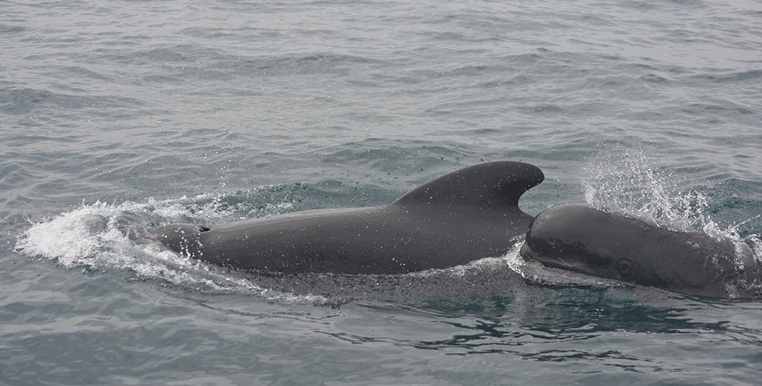
Imagem 1: Long-finned pilot whale (Globicephala melas)
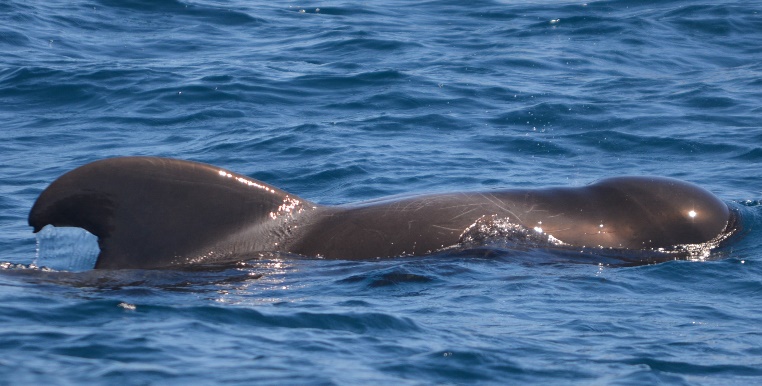
Imagem 2: Short-finned pilot whale (Globicephala macrorhynchus)
In terms of behavior:
- Long-finned pilot whale ( melas): This species frequently displays a behavior known as spyhopping (Image 3), which involves raising its head vertically above the water's surface to observe its surroundings.
During our observations, all encounters with this species (100%) involved curious interactions with the boats.
- Short-finned pilot whale ( macrorhynchus): This species displayed more reserved behavior, showing a lower tendency to raise its head above the water and generally surfacing more discreetly while keeping a greater distance from the boats.
Since the distinction between the two species is not always immediately apparent, the Bolhas Tours team considers a range of characteristics to ensure more accurate identification, including group size, body shape, dorsal fin characteristics, and behavioral patterns. In addition, the team uses photo identification to record sighted individuals and facilitate the recognition of each species.
The Fascinating Social World of Pilot Whales
Beyond their physical characteristics, pilot whales stand out for the complexity of their social relationships. These cetaceans, which belong to the dolphin family, typically live in close-knit groups where individuals form long-lasting bonds and interact through a variety of vocalizations and behaviors.
When observing a pod at sea, you may be lucky enough to witness some of these fascinating behaviors. One of the most impressive is spyhopping (Image 3), which involves the whale raising its body almost vertically, with its head emerging above the water's surface. This behavior offers an unforgettable opportunity to admire its face and the impressive size of its body.
Another behavior you may observe is logging (Image 4), characterized by periods of resting at the surface, during which pilot whales float almost motionlessly in a relaxed posture. Sometimes, several individuals remain close together, side by side, resembling logs floating in the ocean — hence the name of this behavior. Watching an entire pod resting in this way is a particularly peaceful and captivating experience, offering a glimpse into the lives of these extraordinary cetaceans.
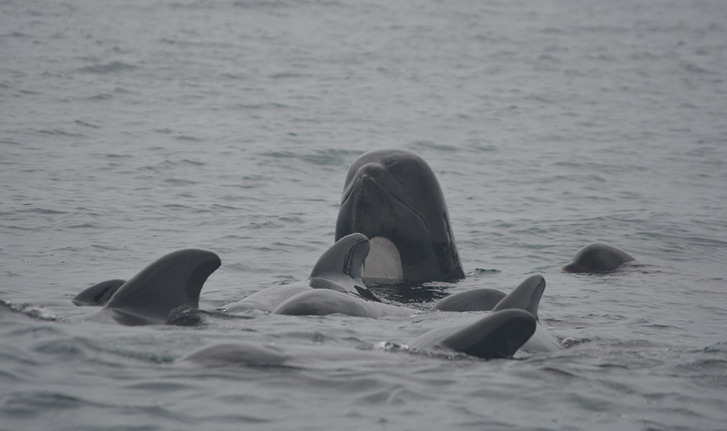
Imagem 3: Spyhopping (Long-finned pilot whale)
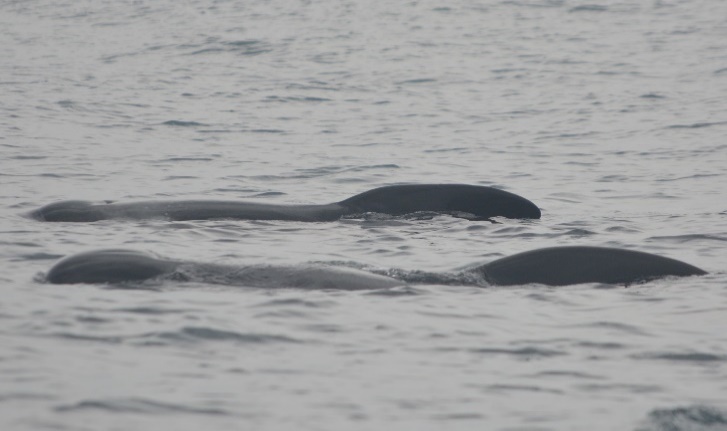
Imagem 4: Logging (Long-finned pilot whale)
Did You Know?
Pilot whales face several threats that put their conservation at risk?
- Accidental bycatch: They are frequently caught in fishing nets and other fishing gear.
- Targeted hunting: They are deliberately hunted in some regions of the world, particularly in Japan and the Caribbean.
- Grindadráp: One of the most controversial practices takes place annually in the Faroe Islands, where thousands of pilot whales, including adults and calves, are killed. The term Grindadráp comes from the combination of two words: Grind, meaning a pod of pilot whales, and Dráp, meaning slaughter.
The populations of the two pilot whale species have significantly different estimates?
The long-finned pilot whale (G. melas) has a global population of more than one million individuals, while the short-finned pilot whale (G. macrorhynchus) has an estimated worldwide population of around 700,000 individuals, approximately 21,500 of which are found in the Northwest Atlantic Ocean (Carwardine, 2019).
Pilot whales prefer deep ocean waters with steep underwater slopes, particularly near submarine canyons and seamounts?
In the Sesimbra region, the Setúbal Canyon and Lisbon Canyon stand out, reaching depths of more than 1,500 meters. These geological features, combined with the abundance of nutrients carried by the Sado and Tagus river basins, make these areas particularly favorable habitats for pilot whales, mainly due to the availability of food.
A Special Encounter at Sea
The chances of encountering these cetaceans during a trip at sea are relatively low, with sightings typically occurring only two to three times a year, mainly in August and September. This makes every encounter even more special and memorable. Between the stunning coastline of Arrábida and the vastness of the Atlantic Ocean, each trip offers an opportunity to discover the diversity of marine life and learn more about some of the less frequently seen inhabitants of these waters.
At Bolhas Tours, we believe that observing marine wildlife goes far beyond simply admiring extraordinary animals. It is also an opportunity to learn more about the ocean around us and understand the importance of marine ecosystems.
Responsible marine tourism is at the heart of everything we do. By observing cetaceans respectfully and following best practices for wildlife watching, we can enjoy these unique encounters while also contributing to the protection of the marine environment on which these animals depend.
